
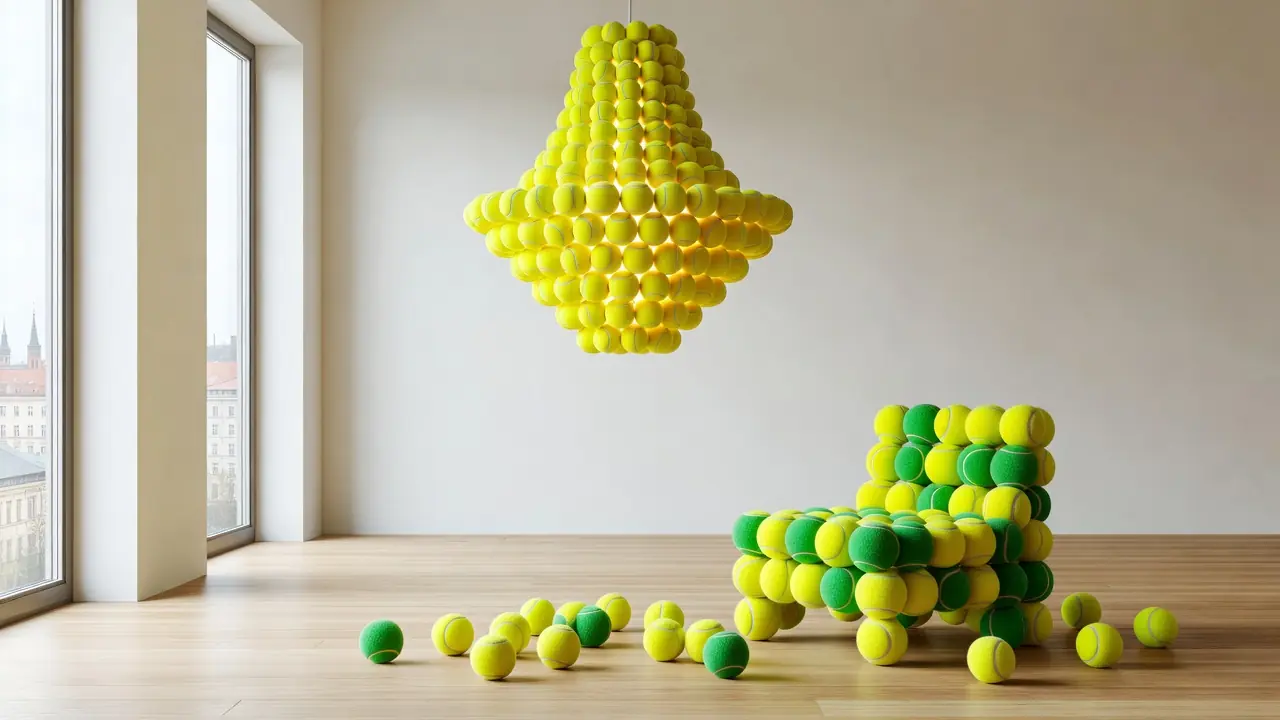
Slovak designer Lucia Kružlicová, founder of LUKRU design, has developed TENNIS, a collection that gives retired tennis balls a second working life as furniture and lighting. The project, shown on the Isola Design platform and ahead of her upcoming participation in Isola Design, treats an everyday material that is usually thrown away as a serious design resource.
From the court to the living room
Kružlicová, who studied at the Technical University in Zvolen and the Slovak University of Technology in Bratislava, builds her work on interior and product design. Her research and teaching focus on emotional design, meaning how the shape of an object can change the way people relate to a room. The TENNIS collection starts from a simple question: what happens when an object made for play moves into a domestic space?
The answer depends on the qualities a tennis ball keeps after its sporting life ends. Its shape is instantly recognizable, its surface is soft, and its color stands out. Rather than hiding these traits, Kružlicová makes them the main features of each piece, which moves the collection away from the conventions of traditional furniture.
Two objects, two different approaches
BALLUSTRIA is a pendant lamp that borrows the silhouette of historic chandeliers and assembles it from reclaimed balls. The contrast between a formal lighting shape and an informal material gives the piece an unexpected kind of elegance. Here the balls serve as both decoration and structure, so reuse is part of the design itself rather than an afterthought.
LOPPY, a children's seat, takes a more playful route. The softness and bright color of the balls suit a piece meant for young users, and the seat's sporting origin connects naturally to the play it is made for. Both objects remain recognizable as tennis balls, which is part of their appeal.
What the project does and does not show
The collection offers a clear example of how a discarded material can be reconsidered. Sustainability and experimentation are central to the work, and the designer presents reuse as a reason to look again at objects people usually regard as temporary. The project is best understood as a design exploration: the supplied material describes the concept and the two featured pieces, but it does not include durability tests, pricing, or information on how the objects perform over long-term daily use.