
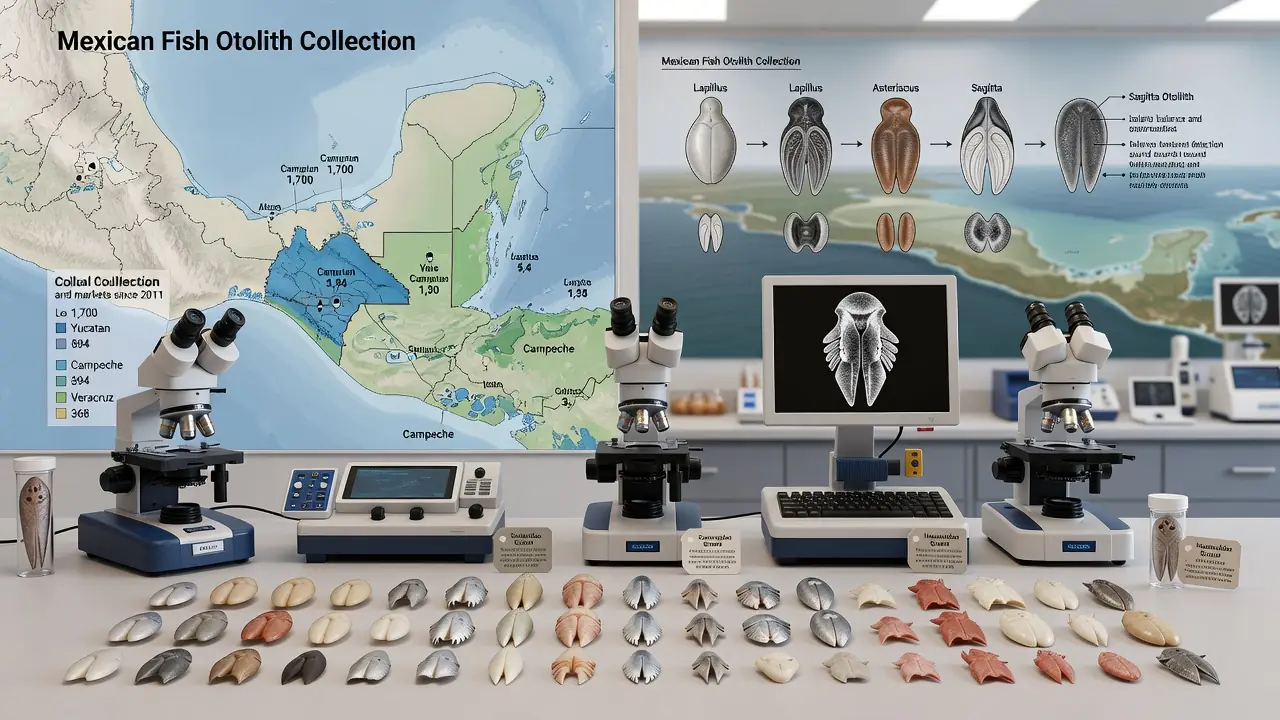
A Mexican research team has put the country's first digital collection of fish otoliths online, offering free public access to 3,001 lots and about 2,600 high-resolution images. The archive covers 214 species from 67 families across the Gulf of Mexico, the Caribbean Sea, and the freshwater and brackish waters of the Yucatan Peninsula. Researchers describe it as a step toward a national platform for otolith data analysis.
What otoliths reveal about fish
Otoliths are calcium carbonate structures that grow inside the inner ear of bony fishes. Each fish has three pairs, called the sagitta, lapillus, and asteriscus, which help with balance, orientation, and sound detection. Because they are deposited in concentric layers and their chemistry reflects both metabolism and surrounding water conditions, they record information about a fish's age, growth, and habitat over its life.
The sagitta is especially useful to taxonomists because its shape, size, and edge features can differ enough between closely related species to tell them apart. The new collection documents this variation, from simple oval forms to structures with projections and notches that are specific to individual species.
How the collection was built and digitized
The team has conducted sampling campaigns since 2011 at several sites in the Gulf of Mexico and the Caribbean Sea, using a range of fishing gear under catch permits from the relevant authorities. Researchers also worked with markets, ports, and local fishermen, and merged in the earlier Mexican Atlantic Fish Otolith Collection. Each specimen was identified to species level and recorded with biometric data, capture location, date, and coordinates.
Preservation method matters for long-term use. Otoliths must come from fresh or frozen fish, since structures stored in unneutralized formalin or alcohol degrade and become harder to identify. Images were captured with an optical stereo microscope and a scanning electron microscope, then standardized and linked to each specimen's data in a public database.
What the holdings show
Sciaenidae, the drums and croakers, is the best-represented family with 17 species, followed by Carangidae with 15 and Haemulidae with 11. Yucatan accounts for the largest share of lots at 1,700, followed by Campeche with 894 and Veracruz with 368. Taken together, the 214 species represent just over 11 percent of the 1,816 species recorded for the Gulf of Mexico and the Caribbean Sea.
Limits and next steps
The researchers stress that digital images complement rather than replace physical specimens, which remain the primary source of verifiable data. Greater online access may also increase visits and loan requests, making proper storage of the physical collection a continuing priority. Funding for maintaining biological collections remains a concern, but the team argues that open access supports taxonomic, ecological, and educational work across borders.