
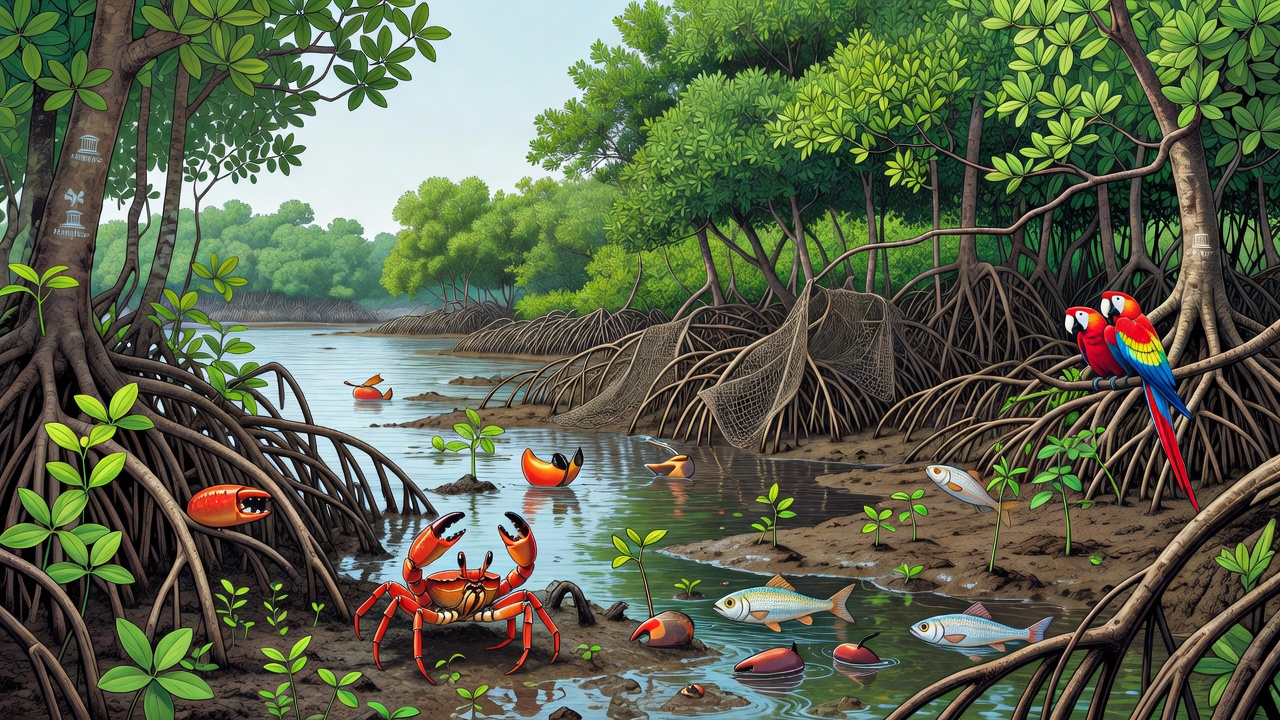
A new comic book, Las Visiones del Manglar, uses a young protagonist named Valentina to explore how coastal mangrove forests sustain life and why they need protection. The work was launched during the 17th Conference of the Parties to the Convention on Biological Diversity (COP17), which takes place in Yerevan, Armenia, from 19 to 30 October 2026. It is published by UNESCO and written in Spanish.
How the Story Works
The comic follows Valentina through three chapters, each examining a different side of mangrove ecosystems. "Las Semillas" introduces her journey, the ecological role of mangroves and the wide range of species they support. "La Gente" turns to local communities, their traditional knowledge and the practical challenge of balancing conservation with the income people depend on. "Las Raíces" addresses the global importance of mangrove restoration, its contribution to climate resilience and Valentina's commitment to protecting these forests.
Illustration, narrative and scientific research are combined throughout. The creators drew on mangroves in biosphere reserves across Latin America and the Caribbean, and the publication incorporates contributions from local communities and experts. The creative team has said the freedom to imagine these landscapes, while respecting the land and its people, was central to the project.
The Project Behind the Book
The comic is part of "Mangrove Restoration as a Nature-Based Solution in Biosphere Reserves of Latin America" (MangRes), an initiative run by UNESCO's Man and the Biosphere (MAB) Programme. It is funded by the Government of Flanders and Spain's National Parks Autonomous Agency (OAPN). MangRes brings together local communities, scientists and governments across seven biosphere reserves in Latin America and the Caribbean. Its approach combines ecological restoration, research, capacity-building and knowledge-sharing.
Practical Uses and Limits
Because the book explains complex ecological ideas in accessible form, it may be useful to environmental educators, policymakers and conservation practitioners looking for ways to engage audiences. Its value as a teaching tool depends on how it is used in classrooms, workshops or community settings, and the supplied material does not describe specific distribution channels, pricing or availability beyond its Spanish-language publication.
A comic can raise awareness, but it does not by itself restore habitat. The initiative's impact will depend on the broader restoration work, research and community collaboration carried out under MangRes. Readers interested in the project's outcomes should look to UNESCO's own reporting on those activities.